

A two-layer strategy pushes perovskite solar cells toward long-term stability
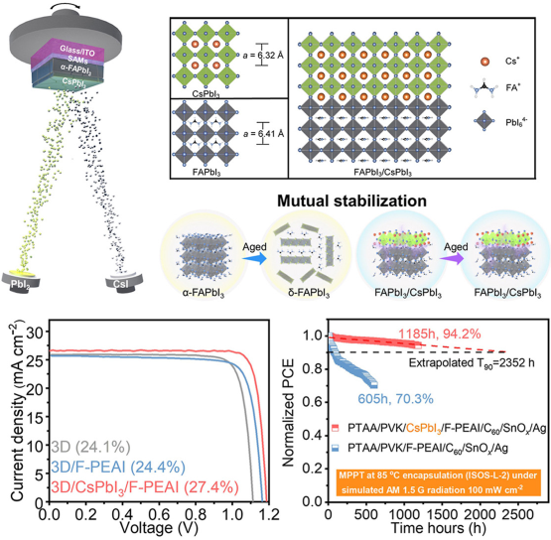
Mutual stabilization strategy enables efficient and durable perovskite solar cells.
FAYETTEVILLE, GA, UNITED STATES, February 3, 2026 /EINPresswire.com/ -- A bilayer perovskite strategy improves long-term stability in solar cellsPerovskite solar cells have achieved remarkable efficiencies, yet their practical deployment remains limited by phase instability and ion migration under heat and illumination. This study introduces a bilayer perovskite design that combines a hybrid organic-inorganic absorber with an ultrathin inorganic capping layer to achieve mutual stabilization. By leveraging lattice matching between the two materials, the approach simultaneously preserves the photoactive crystal phase and suppresses detrimental ion diffusion across interfaces. As a result, the bilayer devices deliver record-level efficiency together with exceptional operational stability, demonstrating a viable pathway toward durable, high-performance perovskite photovoltaics.
Organic–inorganic halide perovskites are widely regarded as promising candidates for next-generation photovoltaics because of their tunable bandgaps and high absorption efficiency. Among them, formamidinium lead iodide (FAPbI3) has attracted particular interest due to its favorable optoelectronic properties. However, its photoactive black phase is thermodynamically unstable at room temperature and prone to transformation into non-functional phases under light, heat, or moisture. Existing stabilization strategies, including compositional mixing and surface passivation, often introduce new degradation pathways, including interfacial strain and accelerated ion migration. Based on these challenges, there is a clear need to develop advanced strategies that simultaneously stabilize crystal phases and suppress ion transport through deeper, interface-focused investigations.
Researchers from Huazhong University of Science and Technology, Hainan University, and collaborating institutions report a new perovskite stabilization strategy, published in eScience in 2026 (DOI: 10.1016/j.esci.2025.100449). The team developed a 3D/3D bilayer perovskite structure, in which an ultrathin (~5 nm) cesium lead iodide (CsPbI3) layer is deposited on top of a formamidinium-based perovskite absorber using a vapor-phase co-evaporation process. Unlike conventional low-dimensional surface treatments, both layers retain a three-dimensional perovskite framework, enabling robust structural coupling across the interface.
Structural analyses revealed that strong lattice matching at the interface favors the formation of a photoactive cubic phase in both layers, despite each material being individually metastable under ambient conditions. This interfacial coupling reduces strain, suppresses phase transitions during aging, and maintains structural integrity under prolonged thermal stress. Importantly, the inorganic capping layer also acts as an effective barrier against ion migration, blocking both intrinsic ions and ligand-derived species from diffusing across the interface, one of the primary causes of long-term degradation in perovskite devices.
When integrated into inverted perovskite solar cell devices, the bilayer design delivered a certified power conversion efficiency exceeding 27% for small-area cells, while large-area devices achieved efficiencies close to 25%. Operational stability tests demonstrated that the cells retained over 94% of their initial performance after more than 1,100 hours of continuous operation at elevated temperatures. These results place the devices among the most stable and efficient perovskite solar cells reported to date.
According to the researchers, the key advance is not a single material improvement but the cooperative behavior between two perovskite layers. By allowing the hybrid and inorganic components to stabilize each other through lattice matching, the design avoids many of the degradation pathways that typically limit perovskite devices. The team emphasizes that this approach shifts the focus from compositional complexity to interface control, offering a more universal and scalable route for improving both efficiency and durability in perovskite photovoltaics.
This bilayer stabilization strategy has broad implications for the commercialization of perovskite solar technologies. By addressing phase instability and ion migration simultaneously, the approach moves perovskite devices closer to meeting industrial reliability standards. Beyond single-junction solar cells, the design concept can be extended to tandem photovoltaics and other optoelectronic devices where interface stability is critical. Moreover, the use of vacuum-deposited inorganic layers is compatible with scalable manufacturing processes. Together, these advantages suggest that rationally engineered perovskite interfaces could play a central role in enabling durable, high-efficiency solar modules for real-world energy applications.
References
DOI
10.1016/j.esci.2025.100449
Original Source URL
https://doi.org/10.1016/j.esci.2025.100449
Funding Information
This work was supported by the National Key Research and Development Program of China [2022YFB4200305 (X. L., Y. R., Z. X. and R. G.)]; the National Natural Science Foundation of China [22279039 (X. L.), 52172200 (Y.R.), 52302254 (R. G.) and 22209068 (X. L)]; the Innovation Project of Optics Valley Laboratory OVL2021BG008 (X. L.); the Foundation of State Key Laboratory of New Textile Materials and Advanced Processing Technologies Grant F22021011(X. L.); the Guangdong Basic and Applied Basic Research Foundation (No. 2025A1515012297).
Lucy Wang
BioDesign Research
email us here
Legal Disclaimer:
EIN Presswire provides this news content "as is" without warranty of any kind. We do not accept any responsibility or liability for the accuracy, content, images, videos, licenses, completeness, legality, or reliability of the information contained in this article. If you have any complaints or copyright issues related to this article, kindly contact the author above.
