

South Korea Compostable Foodservice Packaging Market Growth 2026–2036 Driven by Policy and Delivery Demand
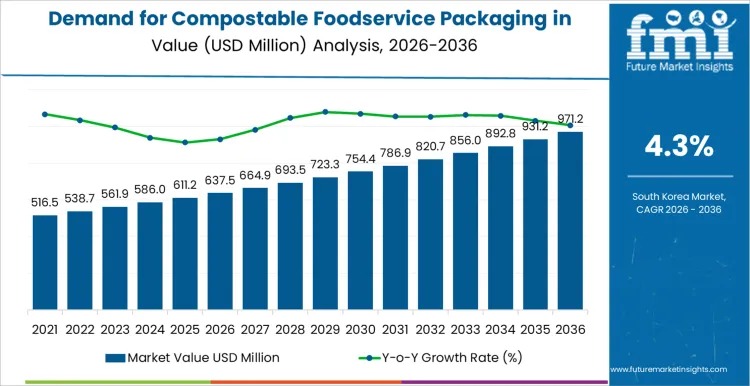
South Korea Compostable Foodservice Packaging Market
South Korea’s compostable foodservice packaging market grows steadily to 2036, powered by green policy, Baedal delivery, and material innovation.
NEWARK, DE, UNITED STATES, January 20, 2026 /EINPresswire.com/ -- Market Overview: Sustainability Becomes Operational Strategy
The Demand for Compostable Foodservice Packaging in South Korea is transitioning from an eco-conscious alternative to a mainstream operational requirement across foodservice channels. The market is valued at USD 637.5 million in 2026 and is projected to reach USD 968.9 million by 2036, advancing at a CAGR of 4.3%. This growth is closely tied to South Korea’s highly developed food delivery ecosystem, or Baedal, which generates substantial volumes of single-use containers daily. Rising environmental awareness among consumers and businesses, combined with tightening regulations on plastic waste, is structurally reshaping packaging demand.
Request For Sample Report | Customize Report | Purchase Full Report:
https://www.futuremarketinsights.com/reports/sample/rep-gb-31566
Policy and Regulation: The Core Growth Engine
Government action remains the strongest catalyst for market expansion. Enforcement of the Resource Recycling Act and the expansion of disposable cup deposit systems are pushing foodservice operators away from conventional plastics. Major cities, including Seoul, now impose stricter penalties on non-compliant packaging, making compostable solutions a cost-avoidance strategy rather than a branding choice. In parallel, South Korea’s Green New Deal policies aim to modernize the national resource circulation framework, accelerating the phase-out of petroleum-based plastics in favor of bio-based and fiber-derived alternatives.
Key regulatory impacts include:
- Mandatory reduction of PVC and colored plastics in foodservice
- Financial incentives favoring biodegradable and reusable tableware
- ESG-driven procurement mandates among large conglomerates
Technology and Materials: Performance Meets Compostability
Early biodegradable packaging often failed to meet functional requirements for Korean cuisine, particularly for hot, oily, and liquid-rich dishes. This barrier is now being overcome through material innovation. Domestic chemical companies and paper manufacturers are co-developing PFAS-free aqueous coatings that deliver oil and moisture resistance without compromising compostability. These advances ensure that compostable containers can withstand soups, stews, and high-temperature delivery conditions.
The industry is also exploring alternative feedstocks:
- Paper & Paperboard dominate with a 38.0% share due to established recycling habits
- Bagasse and agricultural residues provide rigidity and insulation
- Marine biomass (algae and seaweed) is emerging as a future bioplastic source
Segmentation Insights: Where Demand Concentrates
By Material:
Paper and paperboard lead the market, supported by consumer familiarity with fiber waste separation and improved grease-resistant formulations. Fast-food chains rely heavily on these materials for wraps, cartons, and bakery packaging.
By Product Type:
Plates account for 38.3% of total demand. Outdoor dining culture, festivals, and public events drive high volumes of disposable plates, with molded fiber replacing polystyrene foam due to superior strength and compostability.
By End User:
Chain restaurants represent the dominant consumption segment. National franchises face the highest regulatory scrutiny and benefit from economies of scale, making compostable packaging financially viable across thousands of outlets.
Cafe Culture and Bagasse Adoption
South Korea’s strong café culture supports the rapid uptake of bagasse and seaweed-based packaging, which together hold around 24.0% of market share. These materials offer excellent insulation for hot beverages and align with consumer expectations for visible sustainability. Some café chains are experimenting with seaweed-based coatings and edible films, reflecting the country’s leadership in marine biotechnology.
Regional Outlook: Uneven but Accelerating Growth
Growth rates vary by region based on tourism intensity, industrial activity, and local policy enforcement.
- Jeju leads with a 5.1% CAGR, driven by “Plastic-Free Island” and “Carbon-Free Island 2030” initiatives
- South Gyeongsang benefits from ESG-driven demand in large industrial cafeterias
- South and North Jeolla leverage agricultural processing and food clusters to support compostable packaging adoption
These regions are increasingly adopting localized zero-waste models that reinforce long-term demand.
Market Challenges: Infrastructure Gaps
Despite strong adoption, limited industrial composting capacity remains a constraint. Some bioplastics require controlled composting conditions that are not yet widely available, resulting in incineration rather than composting. Addressing this gap will require coordinated investment between government agencies and private waste management firms to unlock full circularity.
Competitive Landscape: Innovation and Localization
The competitive environment features global leaders such as Huhtamaki, Stora Enso, WestRock, Mondi Group, and Georgia-Pacific expanding local production and R&D. At the same time, domestic manufacturers are differentiating through customized designs tailored to Korean dining formats, intensifying competition and accelerating cost reductions across compostable materials.
Related Reports
Pump and Dispenser Market- https://www.futuremarketinsights.com/reports/pump-and-dispenser-packaging-market
Decor Paper Market- https://www.futuremarketinsights.com/reports/decor-papers-market
Poly Drums Market- https://www.futuremarketinsights.com/reports/poly-drums-market
Have a specific Requirements and Need Assistant on Report Pricing or Limited Budget please contact us - sales@futuremarketinsights.com
About Future Market Insights (FMI)
Future Market Insights, Inc. (FMI) is an ESOMAR-certified, ISO 9001:2015 market research and consulting organization, trusted by Fortune 500 clients and global enterprises. With operations in the U.S., UK, India, and Dubai, FMI provides data-backed insights and strategic intelligence across 30+ industries and 1200 markets worldwide.
Contact Us:
Future Market Insights Inc.
Christiana Corporate, 200 Continental Drive,
Suite 401, Newark, Delaware - 19713, USA
T: +1-347-918-3531
Why FMI: https://www.futuremarketinsights.com/why-fmi
For Sales Enquiries: sales@futuremarketinsights.com
Website: https://www.futuremarketinsights.com
LinkedIn| Twitter| Blogs | YouTube
Sudip Saha
Future Market Insights Inc.
+1 347-918-3531
email us here
Legal Disclaimer:
EIN Presswire provides this news content "as is" without warranty of any kind. We do not accept any responsibility or liability for the accuracy, content, images, videos, licenses, completeness, legality, or reliability of the information contained in this article. If you have any complaints or copyright issues related to this article, kindly contact the author above.
